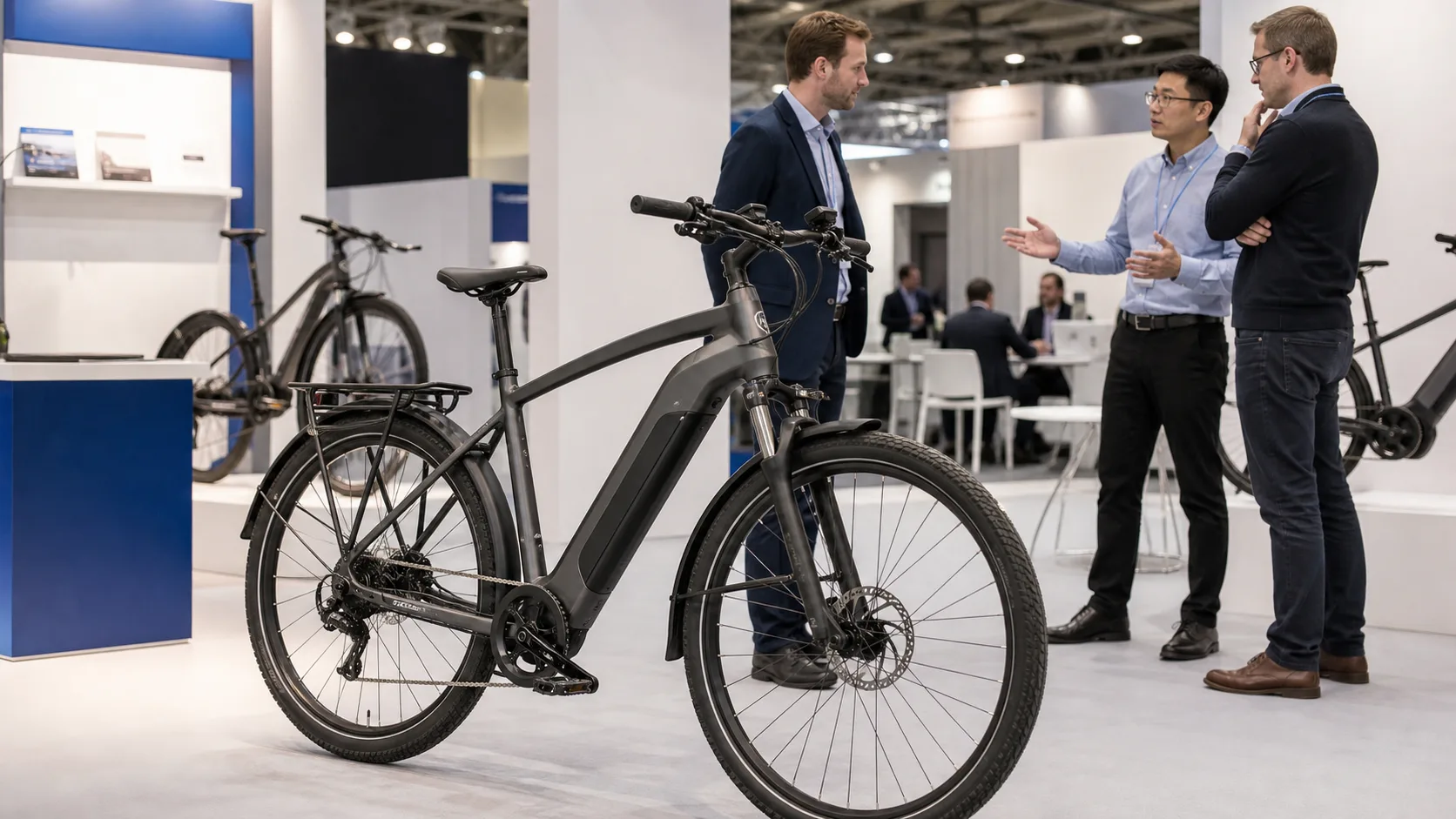
Eurobike opens this week — and it is where the worst sourcing deals begin
Eurobike 2026 runs June 24–27 in Frankfurt, with a revised concept the organiser describes as “more compact, more focused and more future-oriented,” centred on sport, lifestyle and everyday mobility. For sourcing teams that means more categories in one hall, more suppliers to evaluate in less time, and more trading companies presenting polished, factory-looking stands. Buyers tend to compress decisions into show week precisely when documentation and due diligence are hardest to verify.
At a trade show, every supplier looks like a manufacturer. Stands are designed, samples are clean, sales staff are polished. The difference between a vertically integrated factory and a three-person trading company reselling someone else’s capacity is invisible from the aisle — and it only surfaces months later, when a purchase order is delayed, a compliance document does not exist, or a defect batch has no one accountable behind it. Pre-screening at the show is not about deciding who to buy from. It is about deciding who deserves a second meeting.
The four “suppliers” behind most e-bike booths
Before the five checks, it helps to know the four entities behind most e-bike stands. The single best discriminator is to ask to see one specific production line, by name, with a recent photo or a live video. A factory can. A trading company pivots to “our partner factory.”
Four supplier types you will meet at Eurobike
| Type | What they are | Typical signals | Risk profile |
|---|---|---|---|
| Real factory (OEM/ODM) | Owns lines, welds frames, assembles packs, runs QC | Answers process questions; offers a factory tour; knows BOM cost drivers | Lowest |
| Factory-owned brand | Real factory also selling under its own brand | Proprietary models on the stand alongside OEM capacity | Low |
| Trading company | Buys from one or many factories; no production | Vague on process; “multiple partner factories”; no single consistent line | Medium-high |
| Sourcing agent / broker | Pure intermediary representing buyer or factory | Very flexible MOQ, no fixed capacity, “we can source anything” | High |
Check 1: Compliance documentation — available now, not “after the show”
The fastest credibility test is documentation. A compliance-ready factory has test reports on file, with report numbers and lab names, and can share them within the show week — not “after we get back.” Ask for the documents below and watch how quickly, and how specifically, they are produced.
Documents to request at the booth
| Document | What it proves | Red flag |
|---|---|---|
| EN 15194 test report | EU electrical and mechanical safety for the exact model | Generic report not matching the displayed model; no accredited lab |
| UL 2849 / EN 50604-1 battery cert | North American / battery-system safety | “UL listed cell” confused with a UL 2849 system certification |
| Battery UN38.3 + IEC 62133 | Transport safety and cell safety | Missing — blocks shipping and FBA inbound |
| GPSR readiness | 2026 EU market-access obligation | A blank stare — many factories have not heard of GPSR |
| Declaration of Conformity | The legal CE basis | “We will prepare it when you order” |
The tell is timeliness. A factory that already has GPSR on its radar in June 2026 is ahead of the curve. One that does not recognise the term is a compliance liability for your EU launch.
Check 2: Manufacturing capacity — factory or front?
This is the trading-company filter. Show-floor claims — “5,000 units a month,” “in-house battery line” — cannot be verified on the spot, but they can be triangulated. Ask for current monthly capacity and utilisation rate (a real factory knows its utilisation; a trader gives round numbers), the standard lead time for a first OEM order versus a repeat, the MOQ tiers and the price step between them, and which processes are genuinely in-house: frame welding, painting, wheel building, battery pack assembly, final assembly.
Then verify after the show. Book a live video factory tour — not a polished marketing reel, but an actual walk through the welding line, the battery assembly room and the QC lab. Check the business-licence scope to see whether it includes manufacturing or only trading and sales. Request production photos dated within the last ninety days. If battery pack assembly is outsourced, your traceability, BMS firmware control and defect accountability all sit with a third party you cannot audit — a structural risk for EU and US compliance.
Check 3: Battery and drivetrain provenance
The battery is roughly 30–40 percent of an e-bike’s BOM cost and the overwhelming majority of its safety and recall risk. The motor defines the ride and the warranty exposure. A serious factory speaks fluently about both. On the battery, ask for cell-level transparency: the cell brand and model (Samsung 21700, LG M36, CATL, EVE, Lishen and the like) and why that cell was chosen for the target market; the BMS supplier and whether its firmware is in-house or locked to the cell vendor; the pack design — series/parallel configuration, rated versus actual capacity, thermal management and IP rating; and whether a pack serial number can be traced back to a cell batch.
On the motor, ask for application logic rather than spec sheets: mid-drive versus hub and why, for a commuter, cargo or mountain platform; the torque and cadence-sensor strategy behind the riding feel your brand wants; and whether your team can tune the controller’s assist levels or whether it is vendor-locked. These two answers — can they name the cell, can you touch the controller — quietly tell you who actually controls the product you would be selling.
“If the booth staff cannot name the cell brand without checking, the factory does not control its own battery BOM. That is the moment to thank them and walk on.”
Check 4: Customisation depth, IP and commercial terms
A factory’s willingness and ability to customise reveals whether it is set up for an OEM or ODM partnership or simply to move catalog stock. Ask what is changeable at your MOQ versus only at higher volumes — colour, geometry, motor and battery spec, firmware, user interface. Ask who owns new tooling, what it costs, and whether it is amortised or one-time. Ask whether they can support a pilot build of 50 to 200 units before a large PO. Then turn to IP: who owns the design or tooling if you fund it, whether regional or model exclusivity is available and how it is enforced, and whether they have a standard NDA or expect you to bring your own.
Brands that skip these questions at the show often discover, at the second PO, that their “custom” model is being sold to a competitor under a different sticker — because IP ownership was never documented. Close the commercial side too: payment terms for a first order versus a repeat, the warranty policy and who absorbs defect cost, and the spare-parts supply commitment in years after end of life.
Check 5: QC and after-sales infrastructure
A factory’s QC lab and after-sales process predict your warranty cost better than any spec sheet, and this is the check most buyers skip at shows — then regret by month twelve. Ask what they test in-house: frame and fork fatigue and impact, battery cycle, drop and thermal-abuse testing, motor dyno and continuous-load testing, the AQL sampling level on the final-assembly line, and water and dust (IP) validation. Then ask for ranges, not promises: historical defect rate by category (frame, electrical, battery), the RMA process and typical turnaround, the firmware-update path for field issues, and their recall-support capability. A factory that can show a QC equipment list and a real defect-rate trend is operationally mature. One that answers “quality is very good” with no data is not.
Booth red flags versus green flags
A short pattern-recognition list, built from the five checks above, helps you disqualify fast without antagonising the stand. Use it as a private scorecard, not a script read aloud.
“We’ll send compliance docs after the show” · cannot name the test lab · “multiple partner factories” with no single line named · cannot name the battery cell brand without checking · suspiciously low MOQ with “we can source anything” · “anything is possible” customisation with no process · vague on tooling ownership or exclusivity · “quality is very good” with no data · has not heard of GPSR.
Report numbers and lab named on the spot · offers a live video tour of one named line · explains the cell choice against your target market · clear MOQ tiers with price steps · explains what changes at which volume · documented tooling ownership and exclusivity terms · QC equipment list plus defect-rate ranges · already structuring GPSR tech files and a responsible person.
The 20-minute booth meeting script
You will not get deep diligence in a first meeting, but you can disqualify fast. Run these in order and stop early if the answers break down:
1. “Which model on your stand is EN 15194 certified, and can I see the report number and lab?”
2. “Walk me through your battery — cell brand, BMS supplier, and who assembles the pack.”
3. “Which production processes are in-house — welding, painting, battery, final assembly?”
4. “What is your MOQ for a first OEM order, and what changes at 2× and 5× volume?”
5. “Can you support a 50–100 unit pilot build? Who owns the tooling if we fund it?”
6. “What is your in-house QC testing, and what is your typical first-year defect rate?”
7. “Are you ready for GPSR — do you have a responsible person and a tech-file structure?”
A credible factory answers six or seven with specifics. A three- or four-answer profile earns a follow-up video call — not a PO.
Cannot make it to Frankfurt? Pre-screen remotely
Most buyers do not get to Frankfurt. The same five checks work remotely, arguably better, because you have time to verify. Request the document set above before any sample spend. Book a live video factory tour and ask them to walk, not narrate. Order a paid pilot sample of one to five units rather than a free sales sample — paid orders surface real lead time and real BOM. Run a video QC review of the pilot against your spec. Then move to a 50–200 unit pilot build before a container PO. The remote path is slower but filters harder; a factory that will not do a live video tour or a paid pilot sample has told you everything you need to know.
After the show: from booth contact to pilot PO
Eurobike should produce a shortlist, not a purchase order. The funnel that protects you runs in stages, with a clear gate at each step, and none of them skipped. The most common show-sourcing failure is collapsing the first four stages into a single PO signed at the booth.
Show meeting (week of June 24): run the 20-minute script, collect cards and document promises. Gate: six or seven solid answers.
Document review (+1 week): verify EN 15194, UL 2849, UN38.3 and GPSR readiness. Gate: documents match the displayed model.
Video factory tour (+2 weeks): a live walk through welding, battery and QC. Gate: one named, consistent line.
Paid pilot sample (+3–5 weeks): one to five units to your spec, full payment. Gate: meets spec and ride quality.
Pilot build (+8–12 weeks): 50–200 units. Gate: first-year defect rate acceptable.
Container PO (+16–24 weeks): full order, with QC and after-sales terms locked in.
The show gives you volume and access, not the time or tools to verify. Disqualify fast at the booth, then verify slowly with documents, video tours and a paid pilot build.
Lead time, unit cost, IP exposure and compliance accountability all flow from it. Ask for one named production line with a recent photo or live video and let the answer sort the stand for you.
Report numbers, cell brands, defect-rate ranges and a named responsible person are the four data points that separate a compliance-ready factory from a confident one.
A 50–200 unit pilot is the single best de-risking step in e-bike sourcing. A factory that welcomes all five checks is a factory worth that second meeting.
How TXED welcomes all five checks
For brands walking Eurobike this week or sourcing from a desk, TXED runs the same five checks on itself. We hold EN 15194 and UL 2849 test records for our current platforms, supply battery packs built against UN38.3 and IEC 62133 with named Tier-1 cells, and are already structuring technical files and an EU responsible person for GPSR. Our welding, painting, battery assembly and final-assembly lines are in-house in Tianjin and open to a live video tour, and we support paid pilot samples and 50–200 unit pilot builds before any container PO. We would rather lose a fast order to a cheaper trader than win one we cannot stand behind — that is the standard the five checks are meant to protect.