OEM & ODM services for all kinds of Electric bike.
Language
Atuned e-bike stops being an e-bike the moment its 25 km/h limit is defeated — legally, technically and for insurance. EN 15194 type approval voids on the spot; the machine becomes an unregistered, uninsured L1e-category moped under EU law; and when market surveillance spot-checks a retail shelf, it is the brand that answers, not the rider. In 2026, with member-state authorities pressing harder on tuning kits and the new General Product Safety Regulation extending safety duties to cover foreseeable misuse, tamper resistance is no longer an engineering detail. It is a market-access prerequisite.
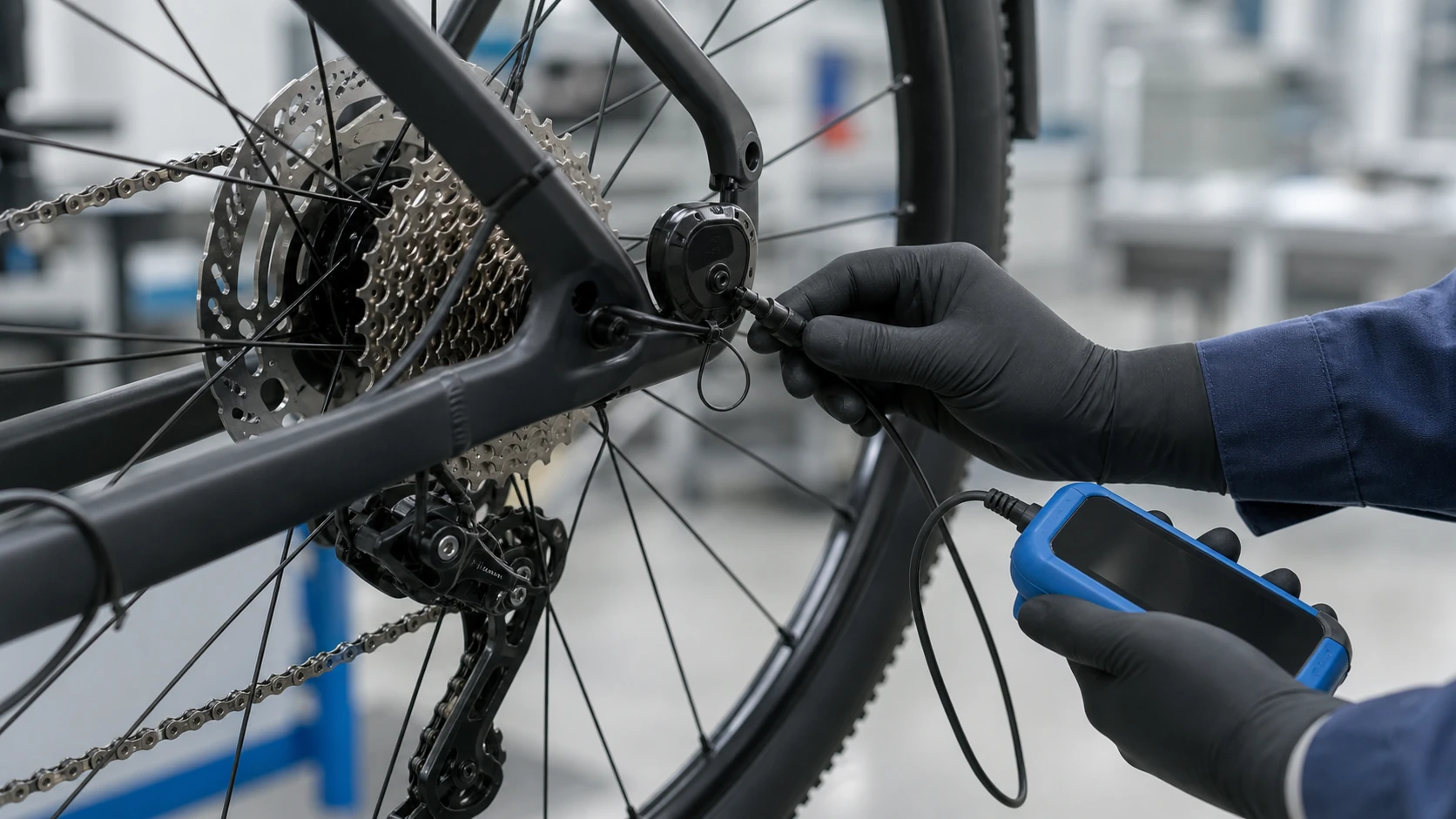
For years the e-bike industry treated derestriction as a consumer problem: riders tuned their bikes, accepted the legal risk, and the supply chain looked away. That calculus has inverted. Under the EU market-surveillance framework (Regulation (EU) 2019/1020), authorities can pull non-compliant products from the market at the brand’s expense, and Safety Gate (the former RAPEX) notifications can trigger cross-border recalls. Member-state authorities — notably in France and Germany — have taken an increasingly firm line on tuning kits and on dealers and brands that enable derestriction, treating a bike that is trivially de-tuned as a non-compliant product rather than a personal-choice modification.
The brand-level consequences compound quickly. A bike whose 25 km/h limit can be defeated in a car park is, in legal terms, no longer an EPAC compliant with EN 15194 — so its Declaration of Conformity is undefendable, its CE marking is invalid, and it falls into the L1e moped category requiring type approval, registration, insurance and a helmet. Customs can hold the container; retailers can refuse the SKU; product-liability insurers can decline the line. And from December 2026, the General Product Safety Regulation (GPSR) widens the exposure further: a product that is foreseeably misused — and a bike that is easy to de-restrict is exactly that — must carry controls against that misuse. Tamper resistance becomes a documented safety control in the technical file, not a footnote in a spec sheet.
The shift in one line: liability for a tuned bike used to sit with the rider who tuned it. In 2026 it sits with the brand that shipped a bike that could be tuned, and with the factory that did not engineer against it.
EN 15194 defines the Electrically Power Assisted Cycle (EPAC) by three hard limits: a maximum continuous rated power of 250 W, motor assistance that cuts off at 25 km/h, and drive that cuts when the rider stops pedalling. The standard’s anti-tampering requirements exist to keep those limits honest — they require that the speed and power controls not be readily overridden by ordinary means. The standard targets casual, ordinary-user defeat (no special tools, no external electronics), not forensic resistance against a determined specialist with a bench and an oscilloscope. That boundary matters: the obligation is to defeat the thirty-second dongle, not to make the bike un-crackable.
The practical consequence for a brand is sharp. A bike whose limit is beaten by a commercial tuning kit — a part sold openly for exactly this purpose — is not compliant with EN 15194, regardless of the certificate the factory handed over at shipment. The certificate covered the bike as built; the moment the speed-control chain is spoofed, that construction no longer exists on the road. For the brand’s technical file, the defensible position is not “we certified the bike” but “we engineered the bike so that the certified construction resists ordinary defeat, and we can show how.”
Derestriction is not magic; it is an injection at one of five points along the speed-control chain. Almost every commercial tuning product on the market attacks the first point — the speed sensor signal — which is precisely why it is the point a factory can harden cheapest.
The chain runs sensor → controller → firmware → human interface → motor output. A tuning kit injects a false signal anywhere along it; the factory’s job is to make the true signal verifiable end to end.
Most casual derestriction dies at the speed sensor. Hardening that one node — and sealing the controller behind it — removes the majority of attack surface for a modest BOM cost.
Replace the raw reed-pulse sensor with a digital, paired sensor-magnet module whose signal is cryptographically bound to the controller. A generic dongle can no longer inject false wheel pulses because the controller rejects any signal that does not carry the pairing. This single change closes Vector 1 and Vector 5.
Pot the controller board in epoxy and secure the housing with one-time / tamper-evident fasteners. This pushes firmware-parameter attacks (Vector 2) from “open the case and attach a programmer” into visibly destructive territory — a tampered controller is obvious on a dealer floor and on a warranty return.
Add a software consistency check: compare wheel speed against cadence and torque. A bike reporting 35 km/h with zero cadence, or a wheel speed that diverges from motor RPM, is being spoofed — the controller flags it, logs it, and can derate. This catches magnet manipulation even when the sensor itself is intact.
Integrate the sensor into a sealed hub or frame mount so the magnet gap cannot be casually shifted or shielded. A sensor the user cannot reposition cannot be fooled by repositioning — the laziest and most common manual tuning method.
Hardware hardening narrows the attack surface; firmware decides whether the surviving surface is defended. The principle is simple: the speed and power limits are constants, not configuration, and any path that could change them must be closed, authenticated, or logged.
The controller runs only firmware signed by the brand or factory key; UART/SWD debug is physically or fuse-disabled on the production image. No unsigned image boots, so a reflashed “chipped” controller will not run.
The 25 km/h and 250 W limits live in read-only or signature-protected storage, not in an editable config field. There is no user-facing and no unprotected dealer-facing setting that raises them.
When the cross-check flags a spoofed signal, the controller logs the event to an append-only store with a timestamp and odometer reading. The log is readable on service — a tuned bike carries its own audit trail into the warranty bay.
Any over-the-air update is signature-checked before install. Dealer-level configuration (assist curves, lights, wheel size) is reachable only behind authenticated service tooling — and can never touch the speed limit itself.
The cost gap between a casually-tunable e-bike and a tamper-resistant one is small at the component layer — and enormous at the liability layer. The comparison below is indicative; exact figures move with volume and motor system.
Open reed-switch speed sensor, raw pulses
Controller with editable speed parameter
Display with a dealer unlock sequence
Unsigned firmware; live debug port
No cadence/speed consistency check
Encrypted, paired digital speed sensor
Potted controller, tamper-evident fasteners
Signed firmware; debug fused off in production
Limits as locked constants, no user/dealer override
Cadence-vs-speed ghost detection + tamper log
Signed firmware means a signing key, and a signing key means a custody question. The factory can hold it and sign every build on the brand’s behalf, handing over a locked, certified product; or the brand can hold its own key and the factory signs against the brand’s HSM or key material. Either is defensible; what is not defensible is an unsigned controller or a key shared across the supply chain. Agree on custody before the BOM is frozen, because changing it later means re-certifying.
The factory’s deliverable to the brand’s technical file is then concrete: a description of the tamper-resistant construction, the test report demonstrating resistance to ordinary defeat, the firmware-signing and key-custody arrangement, and the tamper-log architecture. Under GPSR, this same evidence feeds the product’s risk assessment — tamper resistance is listed as a safety control against the foreseeable misuse of derestriction, with the residual risk and the user warning documented alongside it. The compliance file and the engineering file become the same file.
There is a genuine tension to manage: brands often want dealer-configurable assist levels for regional or rider preference, and service needs some parameter access. The clean resolution is to authenticate dealer configuration for everything except the regulatory limits, and to make the limits structurally un-editable. Service can tune the ride; no one can tune the law.
Six questions separate a factory that has engineered tamper resistance from one that has printed the word on a datasheet.
A tuned e-bike is a compliance incident waiting on a dongle. The factory that closes the speed-sensor signal, signs its firmware, and logs the attempt is the factory that keeps its brand’s CE valid on the road in 2026 — not just on the test bench.