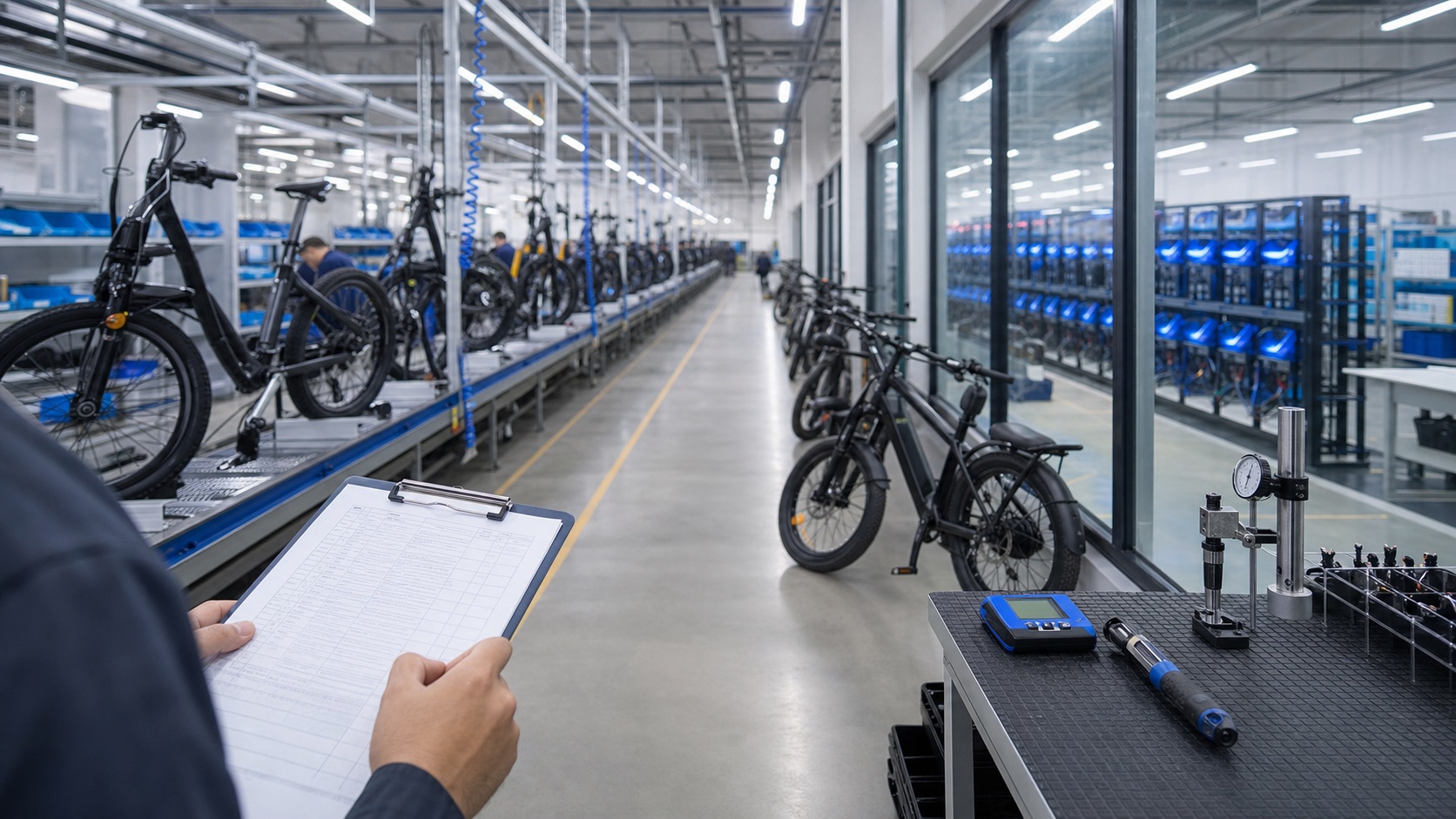
1. Why an on-site visit still matters in a video-call era
Video calls, virtual tours and shared drives have made it easier than ever to evaluate a supplier without leaving your office. They have also made it easier than ever for a trading company to present itself as a factory, for a small workshop to present itself as a mid-volume OEM, and for a real factory to hide a production line it does not want you to see. An on-site visit is the only reliable way to verify that the company on the contract is the company on the floor — that the welding fixtures, paint booth, battery assembly room and end-of-line test rigs in the photographs are the ones currently being used to build orders for paying customers.
The goal of the visit is not to be impressed. It is to verify capacity, process discipline and safety culture against the specification you intend to sign. Treat the visit as an audit, not a sales call. Bring a written agenda, expect to spend at least four hours on the floor, and politely refuse any itinerary that allocates more time to lunch than to the production line.
2. Before the visit: paperwork to request first
A serious supplier will send a basic dossier before you arrive. Asking for it filters out brokers and forces the factory to declare what they actually have. Request a copy of the business licence, factory address with a satellite map link, ISO 9001 certificate (and ISO 14001 if you care about environmental claims), a current organisational chart and a list of the three to five largest export customers by region. Ask for sample certificates — EN 15194, UL 2849, UL 2271, EMC, IP rating — and check that the certificate holder name matches the supplier you are about to visit. Ask for a one-page capacity statement: number of production lines, monthly output, average lead time, and which lines are dedicated to which product family.
If a supplier resists this request, the visit is unlikely to recover the trust gap. If the certificates are issued to a different company name, you are probably looking at a trading company or a sister-factory arrangement — not necessarily a deal-breaker, but a fact you need to confirm in person before signing anything.
3. At the gate: first signals before you walk the floor
Most of what you need to know about a factory is visible within the first twenty minutes. Is there a guarded entrance, a visitor sign-in log and a clear safety induction? Is the company name on the gate the same as the name on the contract draft? Are the loading bays active, with finished bikes leaving on actual trucks, or are they conspicuously empty during peak season? Walk past the bicycle parking and the cafeteria — the size of these tells you more about the real headcount than any number in the pitch deck.
Look for fire extinguishers and emergency exit signage. Look at the floor: oil stains, cluttered aisles and missing safety lines suggest a plant that does not run regular 5S discipline. A factory that cannot keep its corridors clean will not keep its torque values consistent.
4. Frame, welding and paint lines
At the welding line, the questions are about consistency, not artistry. Ask whether welders are certified to an internal standard and request to see the certificate file. Look at the welding fixtures: are they steel jigs designed for the specific frame geometry, or generic clamps being reused across multiple models? Generic clamps are how head-tube angles drift between batches. Pick up a finished frame at random and run a finger along the weld bead — it should be uniform, with no porosity, no undercut and no obvious cold joints.
At the paint or e-coat line, ask what pre-treatment process the frames go through. A serious aluminium-frame factory will run degreasing, rinsing, chromate or zirconium conversion coating, drying, then powder coat or wet paint, then curing. Skipping pre-treatment is the leading cause of paint peeling and warranty returns in coastal markets. Ask to see the paint thickness gauge in use, and ask for a typical reading — a properly coated frame should sit in the 60–120 µm range depending on system. Look at the curing oven temperature log: if the log is blank for the last three days, the process is not being controlled, it is being performed.
5. Battery and electrical assembly — where the risk lives
If you only have time for one detailed inspection, make it the battery and electrical assembly area. This is where product liability lives, where UL 2849 and EN 15194 compliance is won or lost, and where most factory shortcuts are taken. The battery pack assembly room should be a controlled, low-dust environment with anti-static flooring, ESD wrist straps in active use, temperature and humidity logging, and clearly labelled cell storage bins. Cells should be 18650 or 21700 from a named tier-one supplier (LG, Samsung, Panasonic, Sony Murata, BAK, EVE or equivalent) with a verifiable batch code on each cell — not generic unbranded cells with a sticker.
Ask to see the spot welder in operation. The welds joining the nickel strip to the cell terminal should be uniform, with consistent indentation and no burn-through. Ask how the BMS is programmed and tested: a serious factory will run a 100 percent functional test on every pack, recording over-current cutoff, over-voltage cutoff, balancing behaviour and capacity. Ask to see the capacity test rack — rows of packs cycling through controlled charge and discharge — and ask what percentage of packs are sample-tested versus 100 percent tested. For UL 2849 production, 100 percent end-of-line electrical safety testing is not optional.
Check the charger inspection station. Each charger should be tested for output voltage, output current, protection cut-off and label conformity before being boxed. Ask whether the factory uses the certified charger model on the UL 2849 listing, or a generic equivalent. A surprising number of warranty fires trace back to a factory swapping a certified charger for a cheaper substitute partway through production.
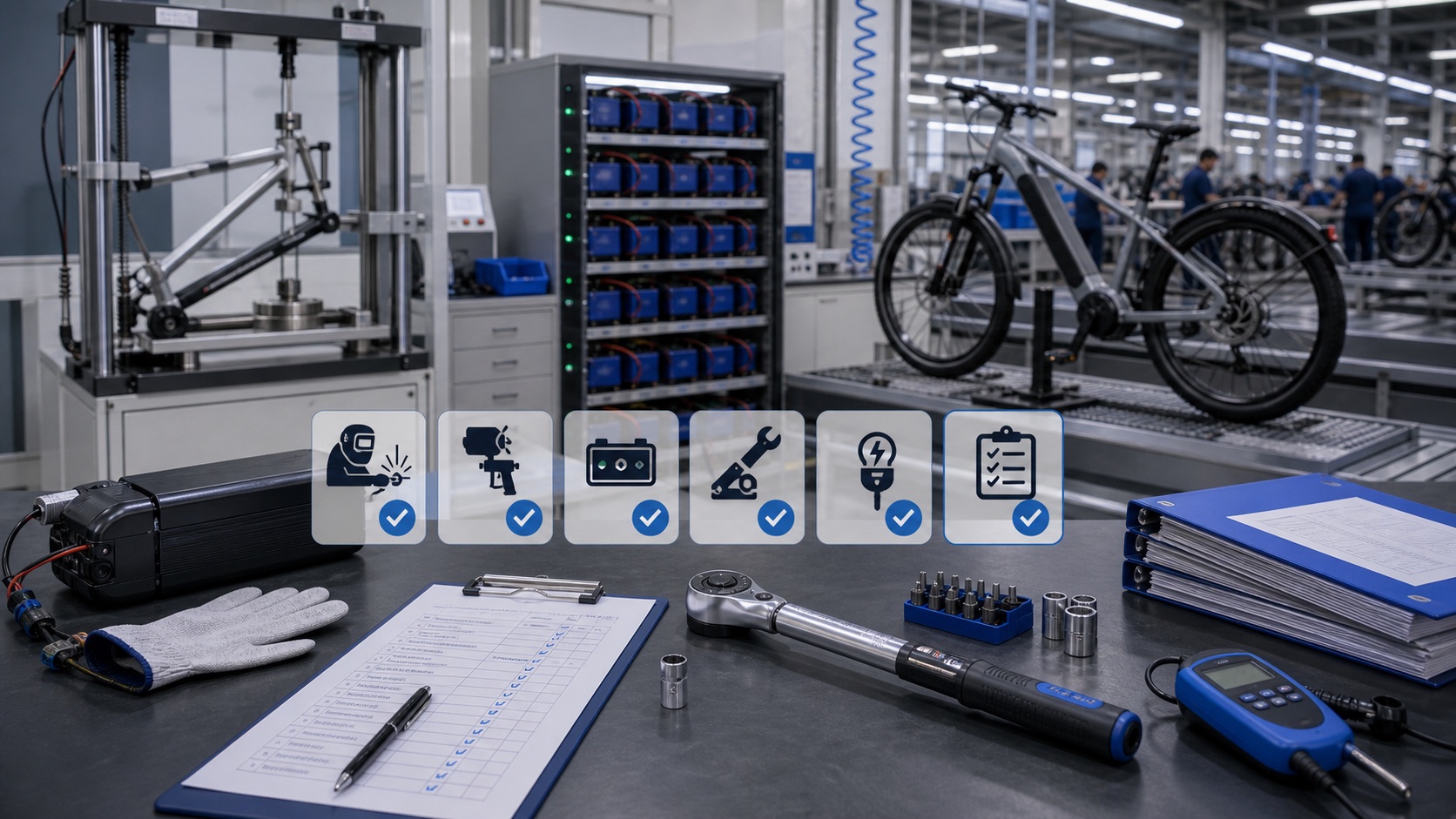
"The cells on the certificate are not always the cells in the box. The only way to know is to walk into the battery room, read the labels on the cell trays and match them against the UL 2271 listing."
6. Final assembly and end-of-line testing
At the final assembly line, look for torque control. Critical fasteners — stem, handlebar, seatpost clamp, brake calliper, motor mount, axle nut — should be tightened with calibrated torque wrenches, and the calibration sticker on each tool should be current. Pneumatic torque drivers should display their target value clearly. Random-spot a station for a few minutes and watch whether the operator actually waits for the click, or pulls away early to keep pace with the line.
End-of-line testing is the moment of truth. A credible e-bike factory will run, at minimum, a brake function test, a lighting and display test, a motor and PAS function test under load on a roller bench, a battery communication and capacity sanity check, and a final visual inspection against a printed checklist. Ask how many bikes are rejected per day at this stage and where the rework loop sits. A factory that claims zero rejects is not telling the truth; a factory that knows its first-pass yield is being honest with you.
7. The QC room: equipment in use, or equipment on display?
Almost every factory has a QC room. Far fewer factories run the equipment in it. Look at the dust on top of the test rigs, the date stamps on the recent test logs, and the personal items at the test stations. A working QC room has used clipboards, half-empty coffee cups and a technician on duty. A showroom QC room has spotless machines, no operator and a printout from three months ago.
For an e-bike factory, the minimum equipment set worth verifying includes a frame fatigue tester (horizontal and vertical loading), a fork impact and fatigue tester, a wheel rotation and runout tester, a brake durability tester, a paint and coating thickness gauge, a salt spray cabinet, a battery cycle test bench and an environmental chamber for temperature and humidity testing. Ask to see the most recent report for each machine, and ask what failure rate triggered the last engineering change. If the answer is “we have never had a failure,” the machine is not being used.
On-site audit zones — what to verify and how
| Zone | What to verify | Evidence to request |
|---|---|---|
| Welding line | Dedicated frame fixtures, certified welders, bead uniformity | Welder certificates, fixture photos |
| Paint / e-coat | Pre-treatment process, coating thickness, oven temperature log | Last 7-day oven log, gauge readings |
| Battery assembly | Tier-one cells, ESD control, 100% pack testing, BMS programming | Cell COA, capacity test logs, UL 2271 listing |
| Charger inspection | Output voltage, protection cut-off, certified model match | UL 2849 listing & charger BOM |
| Final assembly | Calibrated torque tools, station-level work instructions | Torque tool calibration stickers |
| End-of-line test | 100% functional test, roller bench, first-pass yield record | Daily reject log, rework process |
| QC laboratory | Frame, fork, brake, salt-spray and battery rigs actively running | Most recent test reports, by machine |
8. Documentation, traceability and ECN discipline
Production discipline shows up in paperwork. Ask to see a complete production package for an order currently on the line: the bill of materials with revision level, the routing sheet, the inspection plan, the deviation log if any. Ask how engineering change notices are handled — specifically, whether a change to the cell model, BMS firmware, charger or motor is captured, communicated to the customer, and (where required) re-submitted to the certification body. A factory that cannot show you its ECN process is a factory that will silently substitute components when the supply chain tightens.
Ask about traceability. Each finished bike should carry a serial number that maps to a build record: the frame, fork, motor serial, battery pack serial, charger serial, and the operator IDs at each critical station. In a warranty event, this is what allows a recall to be scoped to a 200-unit batch instead of an entire season. If the answer is “we keep a notebook in the office,” you have just identified a risk that will cost real money the first time something goes wrong in the field.
9. Workforce, capacity and the lead-time conversation
Walk the floor with a rough headcount in mind. Count operators at the welding, paint, battery and final assembly areas. A factory quoting 5,000 units per month with thirty operators is either deeply automated, deeply optimistic, or counting two shifts as one. Ask how the workforce is structured: permanent versus seasonal, in-house versus dispatch agency, and what the turnover rate looks like. High operator turnover correlates directly with quality drift in the second half of any large order.
Ask how the factory schedules orders. A capable supplier will explain a master production schedule, allocate your order against named lines on named dates, and explain how peak season (typically March through July for European deliveries) is managed. A vague “don’t worry, we will do it on time” without a schedule is the single most common cause of missed seasonal launches.
10. Compliance, IP and the contractual layer
Before you leave, sit down with the commercial team and walk through the contractual edges. Confirm who owns the tooling if you fund it, who owns the geometry and visual design files, and how the supplier handles confidentiality when the same factory builds for competing brands. Confirm which certifications are held in the factory’s name and which are held in a brand customer’s name — this matters when you need to register your bike for sale and the certificate cannot be transferred.
Confirm the warranty and after-sales process. What is the field failure rate the factory currently sees on its in-house brands? How are spare parts handled in your target market? Who pays for replacement battery packs if a cell-level fault is identified within twelve months of shipment? These are uncomfortable conversations to have on a first visit, but they are far more uncomfortable to have on a Friday afternoon eighteen months later, in the middle of a warranty crisis.
Factories that know their reject rate and rework loop are factories that measure. Factories that claim perfect output are either lying or not testing.
If the UL 2849 or EN 15194 certificate is held by a different legal entity, ask exactly who can manufacture against it and what happens when the relationship ends.
Test equipment that is not in active use is decoration. Ask for the most recent log; if it is older than a week, walk through what is actually being measured today.
ESD control, named-tier cells, 100% pack testing and a documented BMS programming step are the strongest leading indicators of long-term field safety.
Wrap-up: walk the floor, read the logs, trust the evidence
A factory audit is a structured act of verification. Almost nothing on the production floor is hidden from a buyer who knows what to look at; almost everything is invisible to a buyer who arrives without a checklist. The brands that consistently ship safe, on-spec, on-time e-bikes are not the ones that pick the cheapest supplier or the most polished sales team. They are the ones that walk the welding line, read the oven log, count the cells, photograph the torque-tool calibration stickers and ask the awkward questions before the PO is signed.
Use this checklist as your baseline. Adapt it to your category, your target market and your compliance regime. And if a supplier resists any part of it, treat that resistance as data — not as a reason to be more flexible.